Wednesday, 22 June 2022

What to Know about Respiratory Protection Safety Equipment?


What Do I Need to Know About Respiratory Protection Safety Equipment?

When you need safety equipment in Ottawa, don’t forget to include respiratory protection safety equipment. In order to protect your construction workers and other employees, and comply with the Ontario Health and Safety Act, you have to supply protective gear that filters out hazardous gases and dangerous materials.  

Our safety supply store in Ottawa has an array of respiratory protection equipment and air purifiers to meet the needs of customers in different industries, including: 

  • Elastomeric respirators in full-face or half-face  
  • Powered-air purifying respirators  
  • Particulate respirators  
  • Supplied air respirator systems  
  • Reusable and disposable face masks  

How Respirators Protect Your Workers 

Respirators and air purifiers protect workers against numerous hazards including the following: 

  • Insufficient oxygen 
  • Harmful dust and debris 
  • Fogs, smoke, and mists 
  • Gases and vapors 
  • Sprays 

When your workers wear protective respiratory equipment, they face a lower risk of adverse health conditions, including some cancers and lung diseases. These products filter out airborne particles, chemicals, and gases. Make sure you understand the products you purchase from our Ottawa safety supply store as each product targets specific hazards and environments. 

If you need help choosing respiratory protection safety equipment in Ottawa for specific applications, contact one of our representatives for assistance. We can explain the products in our inventory so that you can make the right decision for your employees. 

Contact Ottawa Fastener Supply today for respiratory protection safety equipment advice and information. Check out our blog to learn more about all the safety equipment you should have on your job site to protect your workers. 

Originally Posted on Ottawa Fastener Supply

Monday, 6 June 2022

What Should You Know About Fall Protection Safety Gear?


What Do I Need to Know About Fall Protection Safety Equipment?

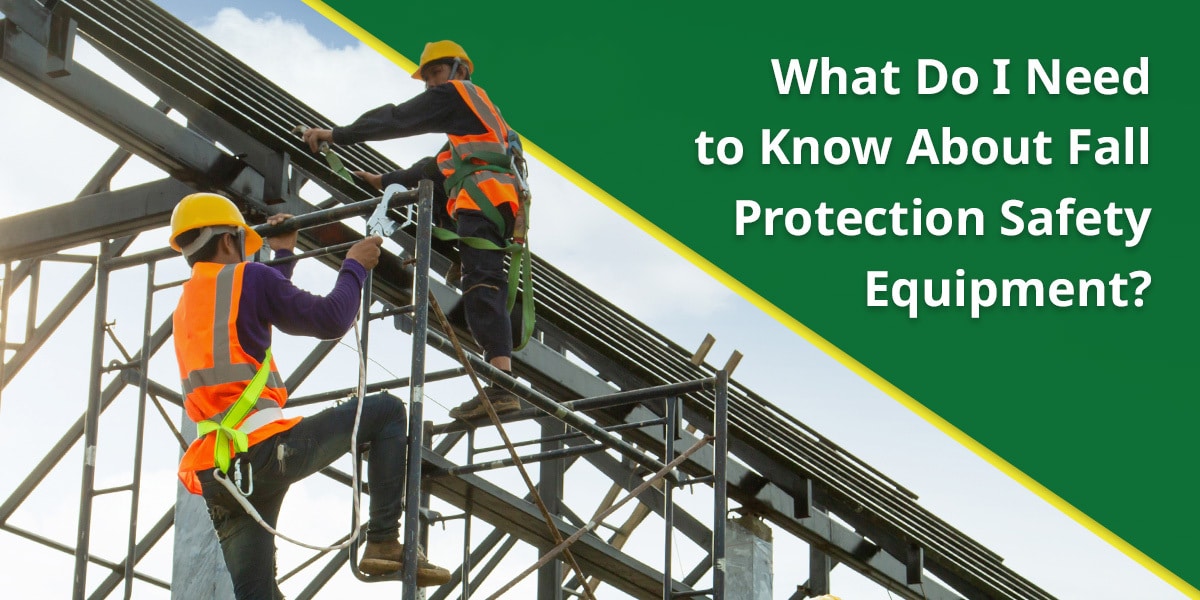
Does your team work at significant heights on buildings, bridges, or roofs? Protect your employees from accidental death, dismemberment, and injury with proven safety equipment. When shopping for fall protection and other gear, choose a supplier knowledgeable about the Ontario Occupational Health and Safety Act. The team at Ottawa Fastener Supply provides real answers about the Ottawa safety supply products we sell.  

Fall Protection Equipment to Keep Your Crew Safe and Secure  

If you need help finding the fall-arrest equipment for a specific industry or job, ask one of our experienced team members for help. To ensure you have a safe and secure job site the essential fall protection safety equipment in Ottawa you need is: 

  • Anchors: Anchorage for ladders, roofs, slings, and other uses 
  • Connectors:  Carabiners, rope grabs, and other high-strength connectors  
  • Harnesses:  Name brand harnesses with up to 400 lb. capacity for climbing, retrieval, evacuation, and work purposes 
  • Lanyards:  Hook up to rebar, scaffolding, and other stable structures with shock and energy-absorbing lanyards 
  • Lifelines:  Cable and polyester lifelines protect your employees. Choose from a variety of lengths and styles. 
  • Signs: Safety and work signs clearly communicate important information.   

Investing in fall arrest equipment makes sure you keep your employees safe and doesn’t need to cost a lot.

Originally Posted on Ottawa Fastener Supply


Monday, 28 March 2022

Protect Your Ottawa Worksite with the Right Safety Equipment


Protect Your Ottawa Worksite with the Right Safety Equipment

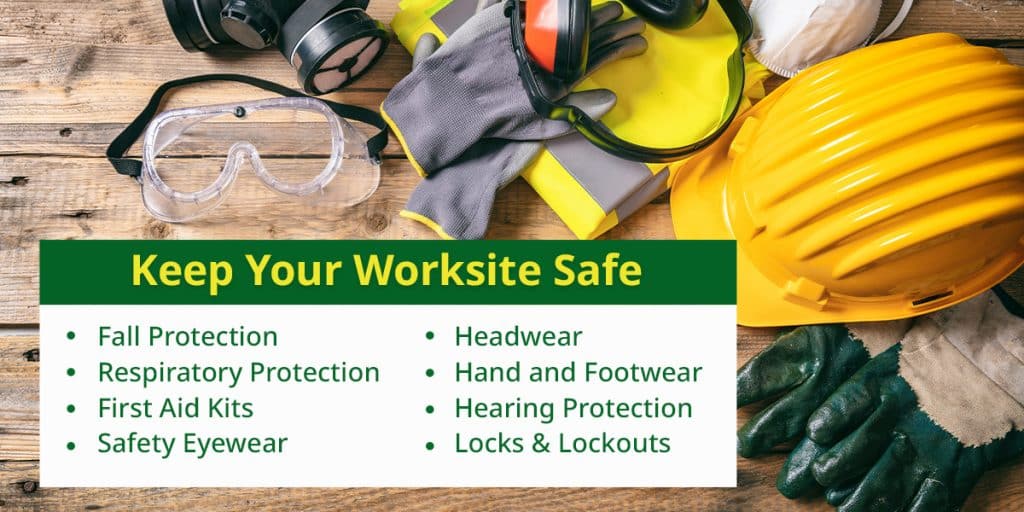
At Ottawa Fastener Supply, we know how important worksite safety is to prevent accidents and to prepare in case of an emergency. For this reason, we dedicate ourselves to providing high-quality safety equipment and gear at affordable prices. As a leading Ottawa safety supply store, we provide all the safety equipment necessary for your construction projects and to meet provincial laws in Ontario. Learn more about our products and how they can benefit your workers. 

Fall Protection

If your employees work at elevated heights, the risk of accidental injuries and death increases significantly. To comply with the Ontario Occupational Health and Safety Act, it’s crucial to provide adequate fall protection and training. Our safety supply store in Ottawa offers a large array of fall protection, including: 

Investing in fall arrest and rescue equipment may cost your company between $50 and $1,000 on average. 

Respiratory Protection  

Under the Ontario Health and Safety Act, construction workers must have adequate, well-fitting protection against hazardous airborne agents. Our safety supply store in Ottawa has a large selection of quality, affordable respiratory protection equipment with price ranges from low to high. Choose from: 

First Aid Kits  

First aid kits are always an excellent idea when working with dangerous tools and machinery, as they can potentially save an individual’s life. According to the Ontario Workplace Safety and Insurance Act, you must have a first aid kit suited to the number of workers. We offer first aid kits by size, components, class, or province. Our 1-5 employee kits are economically priced, while our larger kits, serving a workplace of up to 200 people, can cost around  $100.  

Safety Eyewear  

According to federal and provincial safety regulations, it’s important for construction workers to wear protective gear, including protective eyewear, and have access to emergency eyewash stations when handling chemicals or other hazardous materials. Our safety eyewear and accessories can help prevent wood dust and other irritating materials, electrical sparks, and tools or equipment from harming the eyes. As we specialize in providing safety equipment in Ottawa, you can count on Ottawa Fastener Supply for high-quality eyewear from $2 to $50.  

Headwear 

Protect your employees and adhere to provincial law with help from Ottawa Fastener Supply. Every construction worker on an Ontario construction site has to wear a hardhat when working near: 

  • Areas of potential head injury due to falling objects or debris 
  • Hard-surfaced materials 
  • Electrical conductors and exposed wires 

With our affordable safety equipment, it’s easy to supply a whole team of workers with high-quality head protection and any needed accessories.  

Hand and Footwear  

If you’re looking for premium safety clothing in Ottawa, you can consider Ottawa Fastener Supply your go-to source for a carefully selected stock of protective headwear and footwear. We supply protective gloves, performance and ergonomic gloves, electrical gloves, and thermal gloves to support your specific projects at low-cost prices, from $2 to $50 a pair.  

Hearing Protection  

Hearing protection is critical on most construction sites, as machinery and large equipment can often emit noise greater than ears can handle, leading to hearing loss immediately or over time. In Ontario, it is compulsory to protect workers against sound levels greater than a weighted average of 85dBA during an 8-hour shift. You can rely on our safety supply store to provide efficient earmuffs or earplugs

Locks & Lockouts  

Construction sites are frequently targeted for theft and vandalism. It is important to keep your tools, equipment, machinery, and materials safe and protected by implementing locks. Likewise, you can prevent unauthorized individuals from accessing dangerous machinery by installing lockouts. Although these items are modestly priced, from as little as $2 to only $50, they can greatly help protect valuable resources.  

Contact Ottawa Fastener Supply today for everything from lanyards to face masks designed to comfortably protect your hard-working crews.

Originally Posted on Ottawa Fastener Supply


Thursday, 9 December 2021

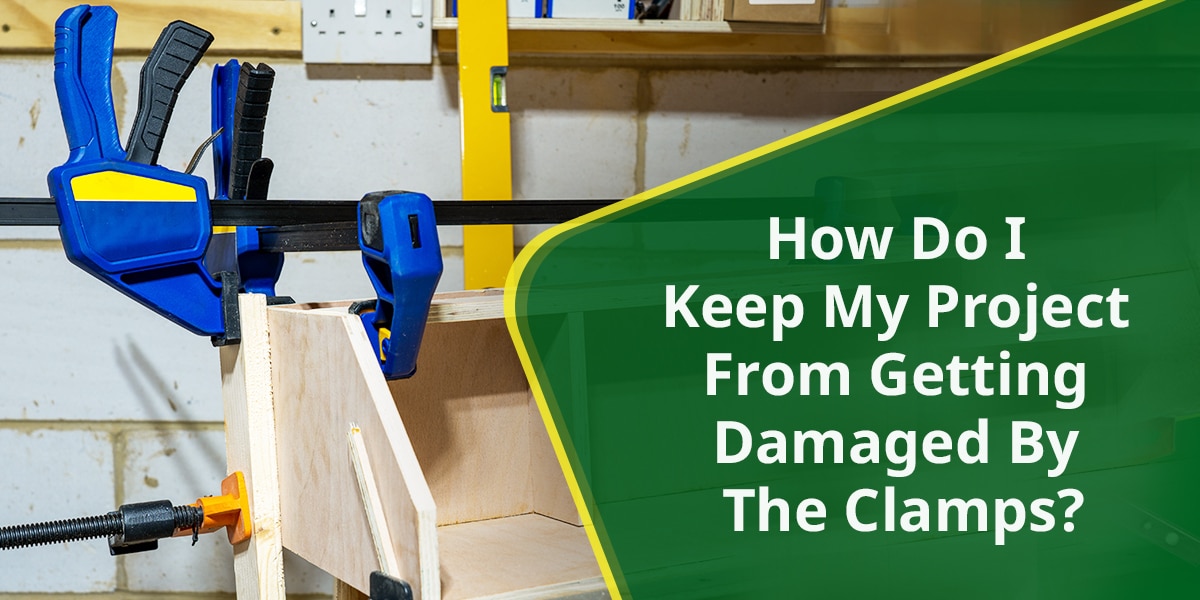
Protect your project from clamp damage with these easy tips


Ottawa Fastener Supply

There are a few tricks and disciplines you can implement to prevent your project from getting damaged during the build. Marring wood or metal after placing much time, energy, and heart into a project can be quite defeating. You also know that Bessey clamps are like another set of hands, and your project may not be completed without them. What can you do to stop potential damage from your clamps? 

Here are some simple tricks to prevent marring when clamping a project together: 

  • Keep them clean. Wipe them off between uses. A craftsperson understands the importance of keeping tools clean and in good shape. The same idea applies to clamps. 
  • Use some wood glue and a clamping caul. Apply a thin layer of wood glue to a scrap piece of wood, and place it between your clamp and the wood. Now, you can open the clamp wide and place it on your project. Instead of having metal or plastic scraping your job, you will have wood-on-wood – a much better choice. 
  • Grab your painter’s tape or a piece of leather. Place the tape on the head of your clamps or insert leather in between the clamp and project. 

Besides knowing how to protect your next project, it helps to know which clamp to grab. Not every type is up to the same tasks and knowing what to use may seem daunting. Check out Ottawa Fastener Supply’s inventory. We have what you need to get the job done and can answer your questions about clamps when you call or contact us today. 


Thursday, 18 November 2021

Maintenance tips to ensure years of use from your clamps


Gunk build-up on your favourite clamps can make life in the shop frustrating. By properly cleaning and maintaining your trusted extra set of hands, you ensure many years of usefulness and productive project builds. Keeping your Bessey clamps clean is the simplest thing you can do to ensure they work when you need them to.  

Tips to keep your clamps in great shape for years to come

  • Remove labels from new clamps and wipe clean.
  • Protect the surface with paste wax.
  • Prevent glue build-up during use.
  • Clean clamps immediately after use.
  • Remove rust.

Thursday, 21 October 2021

How long before I need to replace my clamps?

With regular maintenance and care, you can expect to get many years of use from your clamps. You should never be without these handy tools. Yet, there will come a time when you will need to retire your old ones and buy new ones. How long should you anticipate before you have to breakdown and grab a new set of Bessey clamps? It depends.

Here are some signs that your clamps have reached their usefulness:

  • Glue build-up makes them hard to work with. If you fail to keep your clamps clean and wipe off the glue when you are done with a project, then you may grow frustrated that they no longer work as they did when they were new.
  • Rust has appeared. After a while, rust can start showing up, affecting the sliding action of the clamp. Rust can also make your clamps noisy to use.
  • Overall wear and tear. Ideally, this won’t happen for many years if you make it a point to regularly clean, oil, and store your clamps. However, you may find that all the hours over the years of projects have caught up to the materials, and your clamps no longer work as they should.

No matter how long you keep your clamps, Ottawa Fastener Supply has new ones to replace the old dilapidated ones. Our team is happy to answer your questions about clamps and help you find the best replacements. We stock a huge inventory of clamps, including the tried-and-true Bessey Clamp. Contact us today and get your replacement clamps fast.

Originally Posted here: https://www.ottawafastenersupply.com/how-long-before-i-need-to-replace-my-clamps/

Tuesday, 14 September 2021

10 Things You Should Know About Clamps for Better Project Productivity

 You can never have too many clamps. There are many different types used for specific purposes, and then there are those that are so versatile, no shop would be without them. Do you know what clamp to use when? Ottawa Fastener Supply has tons of clamps available for any type of project. We believe you should know as much as possible about clamps to make better decisions for your upcoming project requirements.

Here are 10 common questions asked about what may be your greatest shop treasure:

1. What are clamps used for?

Clamps are handy tools used to secure parts of a project you are working on. Often, they are used in woodworking and carpentry applications to hold a piece of wood to a workbench for sawing or chiseling. They may also be used in metalworking for welding, grinding, or fabrication since they can hold many different types of metals, like steel, iron, aluminum, and copper. You might use a clamp for drilling, filing, gluing, or painting. Basically, anytime you need something held still so that you can perform one of these tasks, a clamp is the first device you should reach for.

2. How many different types of clamps are there?

The different types of clamps available are numerous. It is possible to have 36 types in your shop or toolbox. For example, you may have a sash clamp for window or door work. You may have a spring clamp that you can operate with one hand and use it for carpentry, jewelry making, or other crafts. Bench clamps will hold your items in place on your bench. Many woodworking shops have bench vices to secure wood together, so you can saw, drill, sand, or plane them. Finally, G or C clamps may be the most commonly used clamp in many woodworking shops.

3. How many different types of clamps do I need to keep in my toolbox at home?

Depending on who you speak with, you may get many different answers as to what types of clamps you should keep in your toolbox. In short, we believe you can never have enough clamps, but if you were to only have a few, here is what we recommend:

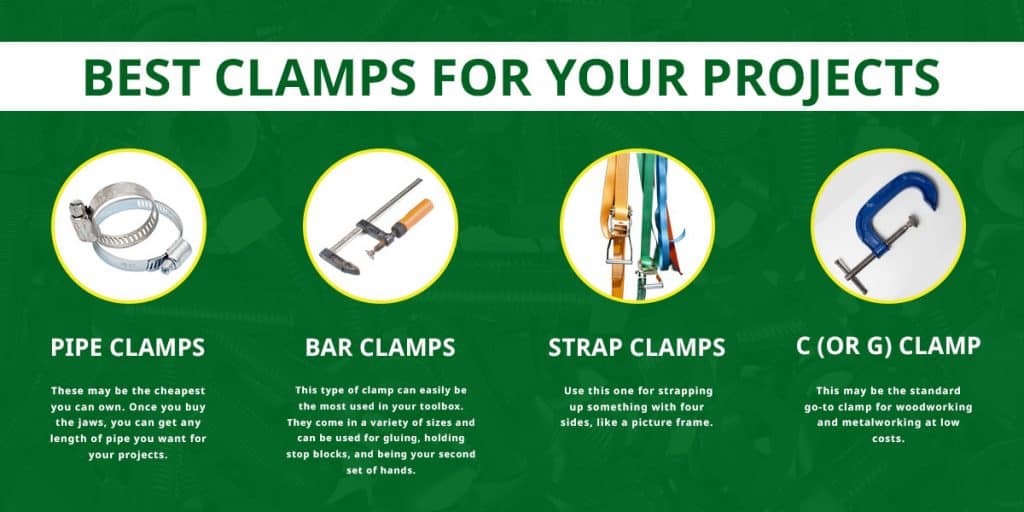
different types of clamps
  • Pipe Clamps – These may be the cheapest you can own. Once you buy the jaws, you can get any length of pipe you want for your projects.
  • Bar Clamps – This type of clamp can easily be the most used in your toolbox. They come in a variety of sizes and can be used for gluing, holding stop blocks, and being your second set of hands.
  • Strap Clamps – Use this one for strapping up something with four sides, like a picture frame.
  • C (or G) Clamp – This may be the standard go-to clamp for woodworking and metalworking at low costs.

4. What type of clamp should I get, if I’m only going to have one type?

If you are starting out building your arsenal of clamps with a limited budget, begin with purchasing pipe clamp fixtures, eight should do the trick. A good size to start with is 2 cm (¾”) fixtures. Next you will need the pipes to go with the clamps. Grab a couple of 2 cm (¾”) pipes in 61 cm (24”) and 121 cm (48”) lengths. To make the pipes longer for bigger projects, grab about four couplers. Bonus Tip: Purchase four 31 cm (12”) long one-handed ratcheting bar clamps for quick clamping situations. These two types together should aid almost all your shop needs until you can purchase more.

5. What are some other types of clamps and what are they used for?

You may be tempted to buy a few of every type, which may leave you overwhelmed when the time comes to use them. While the shop motto is that you can never have enough clamps, it is more important to have the right clamp for the job you are doing. Consider these types and their best-use for your projects:

  • Trigger-Activated Bar Clamp (Quick Clamps) – This amazing clamp can be tightened with one hand while you use your other hand to hold the piece. You can find bar lengths ranging from 15 cm to 127 cm (6” to 50”).
  • Parallel-Jaw Clamp – Use these versatile tools for large glue-ups. They have jaws that remain fixed at 90 degrees to the bar and parallel to each other.
  • C-Clamp or Carriage Clamp – They are great for narrower workpieces when you need lots of pressure at many points, such as a laminating job. Boat builders use these for attaching thin laminations to curved hulls.
  • Corner Clamp – When mitering pieces together, these clamps ensure you get square corners because their jaws are set at 90-degree angles.

6. Which is better: bar clamp or pipe clamp?

It depends on the application. Pipe clamps can be added to your toolbox for minimal monetary outlay. They are very versatile since you can get any length of pipe and create a new clamp. They are especially good for making cabinet components and temporary tabletops. You can even use these clamps for storing ropes and hoses, overhead pipe support, and fixing small leaks. While they offer much in clamping pressure, if you don’t position these clamps in the right place, you could face challenges.

Bar clamps hold large and heavy pieces and can be crossed over another bar clamp for big projects. They are generally used in joinery, carpentry, and sometimes, metalworking. Use these for making furniture and welding. Bar clamps can get pricey, and you are limited by the bar length, so you will have to buy more than a few to fulfil your project requirements. However, they do offer more in pound pressure compared to pipe clamps.

7. How long before I need to replace my clamps?

That depends on how well you care for your clamps. If you leave glue build-up on them, then eventually, you will get frustrated with trying to use them, and you may throw them out. Rust can appear over time. This can affect the sliding action of a clamp and make annoying hinging noises when you use them. Ideally, well-maintained clamps could last you your lifetime. Think of your clamps as tools that could potentially never wear out when given the proper attention with regular cleaning, oiling, and storing. Nothing is foolproof, though, and eventually your clamps will show evidence of wear and tear because of the many projects you create. When that happens, get rid of them and replace them with new ones that will function optimally to deliver the results you want.

8. How do I take care of my clamps?

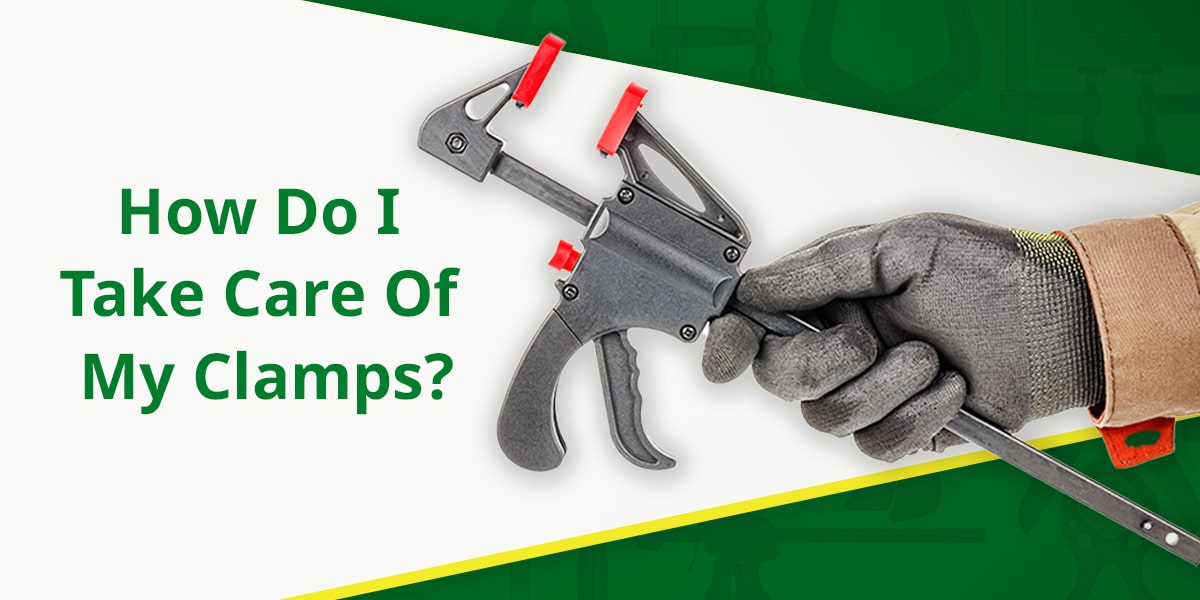
For new bar clamps, begin with removing any labels on the bar, then wiping it down with a clean cloth dipped in mineral spirits. Your goal is to remove any adhesive and the bar is clean. You may even want to add a coat of paste wax to the bar and buff it clean, so you keep glue from sticking later.

While using your clamps, you can prevent glue build-up by using a protective barrier between your clamp and the piece. This barrier can be painter’s tape, packing tape, or parchment paper. After you are done using a clamp on a project, remove it immediately, wipe it down with a dry cloth, and add oil or paste wax as needed to moving parts. Then store them away from heat sources attached to a shelf if possible.

Glue build-up can interfere with your clamp’s ability to move and may damage your project. You can remove dried glue by softening it with a hot rag or heat gun, and then scraping the glue off with a putty knife. For rust, you may try a spray-on rust remover and steel wool.

9. How long should a clamp stay on?

Clamps are temporary tools that are meant to be used short-term. For woodworking projects, you need to remove it once your project is dry or cured. This can be in as little as 30 minutes or may take as long as 24 hours, depending on the glue’s specifications and the humidity in the air. The key principle to remember is to not leave them on for longer than necessary.

10. How do I keep my project from getting damaged by the clamps?

There is nothing like pouring your heart and soul into a project only to have it marred by your clamps. To avoid this, be sure your clamps are clean. Wipe them off if you need to. Then, apply a thin layer of wood glue. Add a scrap piece of wood, called a clamping caul, between your project and your clamp. Open the clamp wide, slide over the piece and clamping caul, and tighten the clamp down. Other options include placing painter’s tape on the part of your clamp that will be in contact with the project or use a piece of leather in between.

Ensure your glue sets well when you apply pressure from the right clamp for the project. If you aren’t sure what works best, then give us a call at one of our convenient locations. We love sharing knowledge and answering questions related to your next project!

Originally Posted here: https://www.ottawafastenersupply.com/10-things-you-should-know-about-clamps-for-better-project-productivity/