While the convenience of cordless power tools makes them extremely valuable for DIYers, as well as professional tradespeople, a key aspect that sets them apart is how long these tools work between recharges. The letters “Ah” or “AH”(“amp-hour” or “ampere-hour”) that you see on your battery essentially denote the charge capacity. The number alongside the letters will tell you the total amount of current the battery will consistently deliver to your tool over the course of an hour. For example, a 2.0ah battery draws 2 amps of power and you will need to recharge it after 60 minutes of continuous use (under ideal circumstances).
Should Battery Capacity Influence Your Choice of Power Tools?
Batteries play a significant role in optimizing the performance of your power tools. Before selecting your power tools, consider some of these aspects related to the tool batteries:
Capacity: What is the battery’s“Ah”? While theoretically a 4Ah battery should last double the time of a 2Ah battery, in reality there are other mitigating factors that determine battery capacity or longevity. This includes construction of the battery (NiCd or Lithium-ion) and the voltage of the tool.
Charging time: How long does it take to recharge the battery to full capacity?
Portability: How easy is it to carry the batteries around from one job to another? What are the potential risks during transportation?
Storage criteria: Is there any specific temperature or manner in which you need to store the batteries?
Cycle life: How many times can you recharge the battery before it needs to be replaced?
At Ottawa Fastener Supply, we carry a large selection of cordless tools, batteries and other accessoriesfrom reputed brands, such as DEWALT®, Bosch, Makita, Milwaukee® and more. Our knowledgeable staff will be happy to assist you in making the best choice for your projects.
Original Source: https://www.ottawafastenersupply.com/what-does-ah-or-ah-mean-on-a-battery/
Cordless power toolsmake life much easier for the DIY-ers and professional tradespeople alike. They carry the same power as their corded counterparts without the hassles of extension cords and generators. Who doesn’t love grabbing their cordless drill and heading to the backyard to finish installing deck boards without having to stretch a long extension cord across the yard?Cordless power tools come with batteries that are the powerhouse behind getting your jobs done. They may seem a little tricky and bring their own questions. With the right answers, you can not only keep that to-do list short, you will have a piece of equipment ready for any task for years to come. Here are twelve common questions about power tool batteries.
What does “Ah” or “AH” mean on a battery?
When you see the letters “Ah” or “AH” on your battery, it stands for ampere-hour or amp hour. It refers to the charge capacity of the battery. That is how much current you can expect to be delivered consistently to your tool over the course of an hour. Let’s say your battery has 2.0Ah. That means it will draw 2 amps of power and will be drained after an hour of continuous use. Keep in mind, this is under ideal conditions.
Is a higher Ah battery better?
In theory, yes, a 4Ah battery “should” last twice as long as a 2Ah battery. However, there are always mitigating factors. For instance, the amperage raw of the tool being used with the battery and how the battery was constructed, play into the longevity of run time you can expect. If the batteries are connected in series, it may double the voltage but not increase the run time of your power tool. When connected in parallel, the run time is longer even though the voltage doesn’t increase.
How long do tool batteries last?
It depends. In general, most major power tool brands (DeWalt, Milwaukee, Makita, etc.) carry a minimum 3-year warranty on their batteries. Of course, there are limitations and external factors that affect the lifespan of your power tool batteries. These factors include the state of the pack’s charge when you stored it and the temperature during storage. Additionally, the location of the battery when stored (on the tool, on a shelf, on a charger or in the tool bag) can affect the lifespan.
How can I repair my power tool batteries?
It is possible to rebuild your power tool batteries if you have the know-how and patience to solder. We recommend using a professional and not doing it as a DIY project on the weekend. While rebuilding batteries is not a service we provide, at Ottawa Fastener Supply, we are happy to test and inspect your batteries and replace those under warranty. Please call our service department for more information at 613.828.5311, ext. 3.
Can I take my power tool batteries on an airplane?
Loose batteries must be placed in your carry-on bag. You can place power tools with their batteries attached in your checked baggage; however, you must be sure they cannot short out or accidentally activate. DeWalt’s new Flexvolt batteries come with an attachment to prevent this from happening. Your best bet is to pack your tools in your checked bags and use carry-on bags for your batteries. Always check with the airline before flying to ensure you are following the rules they set.
Can power tool batteries freeze?
Lithium-ion batteries do not like the cold. They charge slowly or fail to hold a charge at all. Remember to store batteries indoors overnight. When on a job site, keep them in your tool bag with a gel warmer or your pockets next to your body when not in use. If they are left out to endure the elements, do not charge them while they are still cold. Instead, let them warm up to room temperature for an hour or two first.
Are power tool batteries interchangeable?
No. Each brand of cordless power tools has designated battery platforms specific to their line of tools with different voltages. Now, it may be possible to interchange batteries between the same brand and voltage even with different ampere-hours. Before you run the risk of burning up your favorite cordless drill or screwdriver by swapping batteries across brands, give us a call. We are happy to confirm which battery will work for your tool!
How do I charge a battery without a charger?
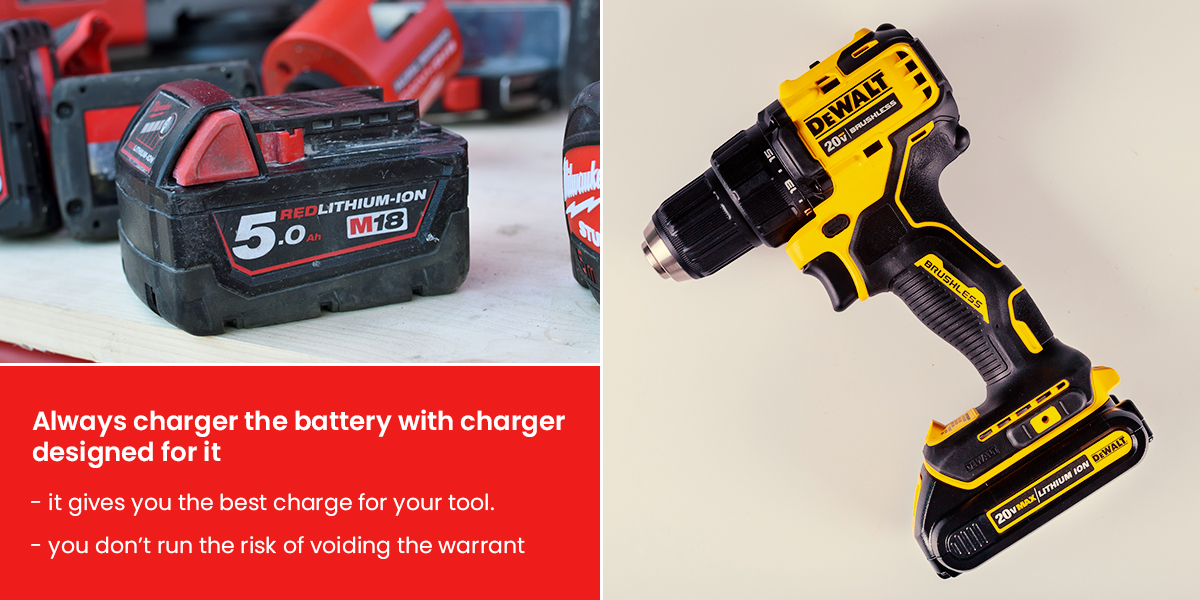
We do not recommend this tactic. As a DIY weekend warrior, your time is better spent on building a deck, not taking unnecessary risks. The best way to charge a battery pack is by using the charger designed for it, for two reasons. First, it gives you the best charge for your tool. Second, you don’t run the risk of voiding the warranty. Give us a call at Ottawa Fastener Supply about the warranties on your power tools and corresponding batteries.
How do I test my cordless drill battery charger?
Any service center across Ottawa should be able to test your charger. Keep in mind that if you think your charger is not functioning, it is more likely that it is the battery, not the charger. Age and overall daily maintenance helps the lifespan of your battery, but they are not built to work forever. Stop in at Ottawa Fastener Supply, and we can inspect chargers of many makes and models. We also can help you find the right replacements.
How do I jumpstart or fix my cordless drill battery?
The best way is to bring the battery into a certified service center. These are not car batteries. It isn’t a matter of linking positive to positive and negative to negative and then turning the key of the dead car. By messing around with your cordless drill battery, you can permanently damage it, and possibly yourself, and void the warranty in the process. Why risk getting a replacement under warranty when you can use the services of a certified center?
How long does a drill battery take to charge?
For brand new batteries, charging it overnight will ensure you have a full charge on each individual cell. From that point on, future charges can take between three to six hours to achieve a full charge. Luckily, newer chargers are designed so that you cannot overcharge your battery, and lithium-ion batteries have little to no memory, so you don’t have to worry about emptying it before placing it on the charger.
How long do cordless drill batteries last?
Brand new batteries should be charged overnight to ensure you have a full charge on each individual cell, so that the life of the cell is not compromised. From that point on, future charges on a the proper/adequate charger can take between 30min to 2 hours to achieve a full charge. Never use under-powered chargers for high capacity batteries. Newer chargers are designed so that you cannot overcharge your battery (though don’t store it here, plugged in), and lithium-ion batteries have little to no memory, so you don’t have to worry about emptying it before charging.
Get Your Power Tool Battery Questions Answered at Ottawa Fastener Supply
When in doubt, check out Ottawa Faster Supply. We have a wide selection of tool batteries and cordless drills, saws, and tools to meet your DIY needs.
We love sharing our knowledge to assist you in making the best choices for your projects. Take advantage of our years of service and experience to ensure your next job is done quickly and easily.
Original Source: https://www.ottawafastenersupply.com/12-common-questions-about-cordless-power-tool-batteries/
The differences between the two line-ups of cordless power tools don’t just come down to colour. But let’s start with the similarities.
Both brands feature powerful lithium ion batteries and over 100 individual tools in their lineups. Both motor designs are brushless for improved efficiency. Both brands have also introduced newer, high-powered batteries enabling cordless operation for heavier tools.
Milwaukee’s basic lineup of cordless power tools, the M18 FUEL, “represents the ultimate synergy of professional grade power, light weight, extreme performance and superior ergonomics,” according to the Milwaukee Tool web site. The web site for DeWALT’s 20V MAX lineup, on the other hand, claims that “all tools come with upgraded features and superior ergonomics.” For extreme performance in the 20V MAX lineup, DeWALT urges users to “step up to the XR series and get advanced electronics, extended runtime and faster application speeds.”
There are differences in the newer, high-powered batteries, however.
The Milwaukee RED LITHIUM HIGH DEMAND battery “delivers up to five times more run time, 35 per cent more power, 50 per cent more recharges and runs 60 per cent cooler than standard 18V lithium ion batteries.” It “provides the next large step towards full corded replacement when paired with the M18” collection of tools.
The DeWALT FLEXVOLT battery “automatically changes voltage when you change tools.” It “brings power to a whole new lineup of tools” and is backwards compatible with the 20V collection.
The Tool and Equipment Store, your Ottawa tool store, carries the full lineups of Milwaukee and DeWALT cordless power tools.
Milwaukee’s lineup also comes with a mobile app that “combines a free-to-use inventory program with the industry’s smartest tools.” The REDLINK PLUS intelligence hardware and software enable “online and mobile record-keeping and simplified tool and equipment management, including security – allowing you to lock your tools and disable them remotely; tracking – to track your tool’s location from anywhere; and reporting – to view your tools’ usage and performance data.”
Finally, the Milwaukee M18 FUEL and DeWALT 20V MAX lineups each offer battery kits containing either one or two batteries. Both the Milwaukee and DeWALT lineups of cordless power tools are designed for tough jobs and tested on real-world work sites. Both are valuable for either heavy industrial or do-it-yourself week-end use.
Does it come down to colour? You decide. Compare and contrast the Milwaukee and DeWALT cordless power tool lineups yourself to take into account the features and benefits that matter most to you.
Better yet, stop in and consult the experts at The Tool and Equipment Store, your Ottawa tool and hardware store, before making your decision. Colour never looked so good in your hands!
Originally Posted here: https://www.ottawafastenersupply.com/brand-red-or-brand-yellow-in-cordless-power-tools-a-tough-choice/
Many tools can do the job, but few can do it like Milwaukee’s FUEL line. This revolutionary series of cordless tools features brushless technology, Red Lithium batteries, and intelligence software packed in 18 volts of power. If you are ready to handle the toughest jobs whether on the job site or in your backyard, then you want the best. Eager to know more about Milwaukee’s FUEL line of tools?Here are the key features that will make your next project fast, efficient and easy:
They are engineered to withstand both heavy-duty jobsites and weekend honey-do lists with ease.
They run cooler than other cordless tools. They even have a longer runtime and charge faster than Milwaukee’s own M18 REDLITHIUM line.
They are designed with a POWERSTATE brushless motor for longer wear, giving you much more useful life for your investment.
Their batteries can cross over from the old M18 batteries to the FUEL line of tools. Keep in mind that Milwaukee’s V18 system will not work in an M18/M12 system.
They can be tracked with Milwaukee’s One-Key digital platform. It helps you manage your inventory of tools across a network of users.
Source the Milwaukee FUEL Line of Tools from OFS
Choosing the right equipment to get a job done is paramount. Milwaukee’s FUEL line makes the choice a simple one. Ottawa Fastener Supply makes it even easier with our large selection and expertise in power tools. Visit us at one of our convenient locations or call today and ask us for more information. We love to share our knowledge and experience so that you can get the results you seek.
Originally Posted on: https://www.ottawafastenersupply.com/what-is-the-milwaukee-fuel-line-of-tools-should-you-make-the-switch/
1. What’s the difference between 20V & 60V DeWalt batteries?
It depends on the use. If you are working under heavy-duty situations, say you are a cut man on a residential job site, the 60V batteries can handle the stress that comes with the territory. They labour less under load and run cooler than the 20V batteries. Also, the 60V changes its voltage draw based on the tool it is used in. Basically, one battery pack can run several tools.
2. Can I use my 20V battery in my 60V tool and vise versa?
The short answer is no. 20V batteries are exclusive to 20V tools. For example, you cannot use your 20V reciprocating saw’s battery pack in your 60V hammer drill. However, you can take a 60V pack and use it in a 20V, 60V, and 120V(60V x 2) tools like your brushless impact driver.
Keep in mind that the interchangeability stops at the device. It is imperative that you charge your 60V battery in a 60V FlexVolt charger.
3. Which of the DeWalt Voltage systems are obsolete?
At the head of the pack are the 8V and 14.4V systems. None of these are supported as much as the newer versions and are almost entirely phased out. Close behind them is the 18V system. You can still find tools and batteries for sale, but these are in the process of being phased out. The 24V and 36V tools are already discontinued.
Like the 18V system, you can find batteries and chargers if you have equipment with these voltage requirements.
4. How do I know when my battery is fully charged?
On a DeWalt charger, there is a red LED light that flashes while charging your battery. When it stops flashing and glows continuously, the battery is fully charged and ready for use. For other manufacturers, consult the instruction manual.
5. Should I leave my battery in the charger when it is finished charging?
To get the most life out of your battery, you should remove it from the charger once it has finished charging. The problem with overcharging is the potential damage to the battery which can shorten its lifespan and leave you in a lurch if it quits in the middle of a project. Of course, be sure to read your tool’s instructions as they may indicate that storing your battery on the charger is fine.
As a side note, using and charging your battery regularly will help extend its life. So, charge it fully, use it regularly, and store it properly to get maximum use time.
6. Should I remove the battery from the tool when I’m not using it?
Generally speaking, unless the trigger is activated on the tool, the battery should have no effect. It is good practice to keep the trigger in a locked position when not in use, especially if it is being stored in your work truck and gets bounced around when in transit from site to site.
7. How long will a fully charged 20V battery last?
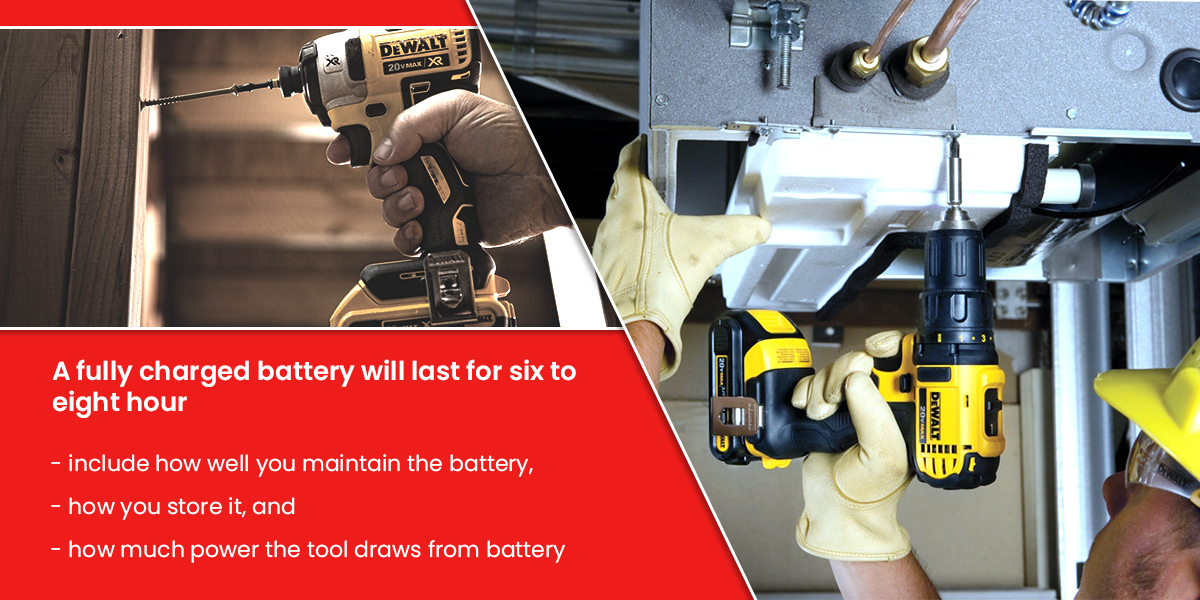
It depends. Several variables will determine the length of a charge you can expect and the life of the battery. These factors include user behavior, ambient temperatures, storage habits, and capacity.
Do you throw it loosely in the same toolbox that your saws, hammers, and screwdrivers bounce around in? It’s better to store it in the original carry case or cushioned bag.
DeWalt warranties their Lithium-ion batteries for three years. If you take great care, you can expect them to last much longer.
8. Can a battery charger be used with a generator?
You should check with the manufacturer before plugging in your battery charger to your generator. Each generator gives off different variations in voltage and current and may affect the charge. All DeWalt chargers, except for the DW9106, are designed to withstand the fluctuations delivered by generators.
9. Does DeWalt make all of their tools in every voltage they offer?
No, but most tools are available in both 18 and 20 voltages. DeWalt does make an adapter so you can use a 20V battery in your 18V impact wrench. They continue to expand their 20V line of cordless power tools, which is good news. When your trusty 15-year-old compact drill malfunctions or is finally phased out, you can upgrade.
At this time, the 60V Flexvolt line is less diverse but growing.
10. How do the 40V Max Outdoor Power Tools fit into DeWalt’s line-up?
This line targets heavy outdoor power equipment users such as landscapers. The battery packs are larger and include more cells. The FlexVolt is not compatible with this line of outdoor tools.
Originally Posted here: https://www.ottawafastenersupply.com/faq-dewalt-battery-voltage-ottawa/
With the number of brands out there, it’s common for users to think, “Are Milwaukee tools any good?” The answer is a resounding “yes”. When you want the best, look no further than Milwaukee Tools. They are a legend in the industry because they listen to the needs of the contractor and DIYer and then put it into practice. All the time spent in the field evaluating how you utilize your tools resulted in the easy-to-use, professional grade M18 cordless system. They didn’t stop there. Continual research into the demands put on tools with all the cutting, drilling, and tightening soon saw the evolution in the M18 FUEL lineup. You demand the best; Milwaukee delivers with many industry firsts, such as cordless:
Grinders
7-1/4” circular saws
Sawzall
Deep cut band saws
Not only did Milwaukee devote their energies to the world of professional grade cordless tools. They made 2010 the Year of Redesigning of their entire line of hand tools. One example of their redesign is a more comfortable wrench with a thick handle to loosen stubborn rusted bolts.
Ottawa Fastener Supply has the Full Line Up of Milwaukee Tools
For over 90 years, Milwaukee has produced an extensive line of tools, including power, hand, pneumatic, and outdoor equipment. Their goal is to conceive, design, and build the best tools for your money. This means you can depend on a straight cut from your cordless circular saw for hours or dependable grinding on the jobsite. There are other popular brands, but nothing compares to the manufacturer warranty, tool variety, and cost of a Milwaukee.
Check out the wide selection of Milwaukee Tools at Ottawa Fastener Supply. We pride ourselves on carrying the best in power tools and love sharing our knowledge to help you make the best choice. Come in and take advantage of our years of experience to make your next job or project go off without a hitch.
ReinoldMax fire extinguishers are the latest addition to Ottawa Fastener Supply’s extensive safety supplies lineup. These aerosol fire extinguishers provide many benefits over and are easier to use than traditional styles, without requiring maintenance or inspections. With the ability to extinguish all major fire types, they are an excellent option for home, workshops and businesses.
ReinoldMax Fire Extinguisher Benefits
With ReinoldMax you get a lightweight, easy to use extinguisher that contains water and a specialty firefighting foam that is non-toxic and safe to use. Since it is in aerosol form, as long as there is product in the can, the fire extinguisher is ready for use. Other benefits include:
Easy storage and an efficient fire control device
Quickly limit the impact of fire due to ease of use
No damage or staining to equipment
Use safely on electrical components and appliances up to 1000v at a distance of 1m
Spray foam offers easy cleanup after a fire
Ecological, safe for all users and biodegradable
Does not harm the ozone layer
Economical
ReinoldMax fire extinguishers are an efficient and safe way to handle fires in classes A,B, C and K, making them an excellent choice for fire safety.
How to Use ReinoldMax Fire Extinguishers
These fire extinguishers are easy for anyone to use since they are in aerosol can format and do not carry the weight of traditional styles. To extinguish a fire, simply follow these steps:
1-Holding the fire extinguisher in one hand, depress the red button on the handle to unlock the unit.
2-Point the can toward the fire and spray the foam over all ignition sources.
3-Spray using a downward sweep, generously covering the flames entirely so they will be smothered.
4-Call 911 if necessary.
That is all there is to extinguishing a fire using ReinoldMax fire extinguishers. The foam smothers the oxygen that feeds flames, effectively putting out the flames and starting the cooling process immediately. Once the foam has been dispersed and the fire is out, cleanup is easy and provided it is not damaged by fire, the foam does not ruin equipment! Be sure to replace your fire extinguisher if you have used a significant amount of foam so you are prepared in the future.